Face Shape Detector: What Is My Face Shape?
Find a useful starting point for hairstyles and glasses. Compare your outline with six common face shapes, or use AI photo analysis for a free face-shape and symmetry estimate.
Start free — no sign-up or card required
Get a face-shape estimate from your photo
Upload a clear photo
Click here or drag and drop your image
Choose one front-facing photo in even lighting
Compare face shapes and styling ideas
These simplified outlines are a visual guide, not diagnostic templates. Mixed shapes are common. Choose a shape to read hairstyle and glasses ideas; personal taste, hair texture and fit matter too.
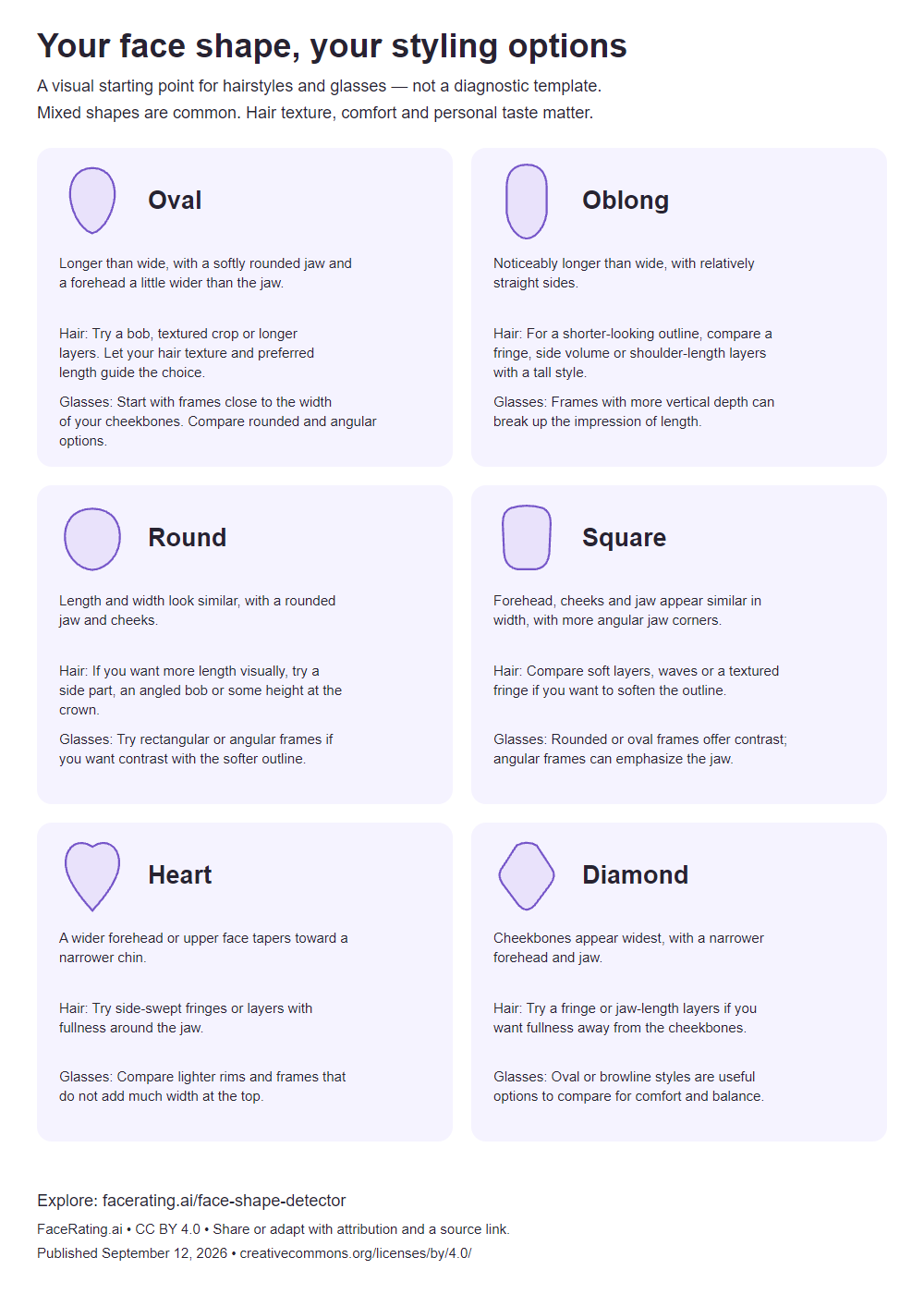
Save this free chart for your next haircut or glasses fitting. You may share or adapt it with credit to FaceRating.ai and a link to this guide under CC BY 4.0.
For creators and publishers: embed this chart
Use the image with attribution, or adapt the SVG and identify your changes. The kit includes the chart, haircut worksheet and aggregate dataset with its methodology. These are model analyses, not a population survey.
How to use the chart and plan your next haircut
Oval
Longer than wide, with a softly rounded jaw and a forehead a little wider than the jaw.
Show styling ideas +Hide styling ideas −
Hair: Try a bob, textured crop or longer layers. Let your hair texture and preferred length guide the choice.
Glasses: Start with frames close to the width of your cheekbones. Compare rounded and angular options.
Oblong
Noticeably longer than wide, with relatively straight sides.
Show styling ideas +Hide styling ideas −
Hair: For a shorter-looking outline, compare a fringe, side volume or shoulder-length layers with a tall style.
Glasses: Frames with more vertical depth can break up the impression of length.
Round
Length and width look similar, with a rounded jaw and cheeks.
Show styling ideas +Hide styling ideas −
Hair: If you want more length visually, try a side part, an angled bob or some height at the crown.
Glasses: Try rectangular or angular frames if you want contrast with the softer outline.
Square
Forehead, cheeks and jaw appear similar in width, with more angular jaw corners.
Show styling ideas +Hide styling ideas −
Hair: Compare soft layers, waves or a textured fringe if you want to soften the outline.
Glasses: Rounded or oval frames offer contrast; angular frames can emphasize the jaw.
Heart
A wider forehead or upper face tapers toward a narrower chin.
Show styling ideas +Hide styling ideas −
Hair: Try side-swept fringes or layers with fullness around the jaw.
Glasses: Compare lighter rims and frames that do not add much width at the top.
Diamond
Cheekbones appear widest, with a narrower forehead and jaw.
Show styling ideas +Hide styling ideas −
Hair: Try a fringe or jaw-length layers if you want fullness away from the cheekbones.
Glasses: Oval or browline styles are useful options to compare for comfort and balance.
Want to explore cuts by length and masculine or feminine style? Use our hairstyle recommendations. This guide is free to browse; AI photo analysis and generated try-ons follow the access shown in each tool.
How to check your face shape
- Use a straight-on photo with a neutral expression, even light and your hair away from the forehead and jaw.
- Compare the visible face length with the width at the cheekbones. Look for a longer, rounder or more angular outline.
- Compare the forehead, cheeks and jaw. Notice where the face looks widest and whether the jaw is curved or angular.
- Read the closest two descriptions in the guide. Mixed shapes are useful descriptions too; there is no need to force one label.
A close wide-angle selfie or tilted head can change apparent proportions. This comparison does not provide physical measurements or a validated accuracy percentage.
What an example result means
Illustrative example, not an analysis of your photo
Oval / oblong
The outline appears longer than wide, with a softer jaw. Both labels may be useful when comparing styles.
Try comparing side volume or a fringe with a taller hairstyle. Choose the version you prefer rather than treating the category as a rule.
Explore hairstyles by shape and lengthYour full report may use a different label or describe a combination. A shape estimate does not tell you what haircut you must wear or how attractive you are.
Face shapes in our analysis dataset
Our published sample contains 17,032 analyses. These are model-generated labels from submitted photos, not a representative survey of people or an independently validated classification. The same person may contribute more than one analysis; the counts should not be read as unique individuals.
| Label | Share of analyses |
|---|---|
| Oblong | 44.4% |
| Oval | 42.3% |
| Round | 6.7% |
| Square | 2.6% |
| Mixed / hybrid | 3.7% |
| Other labels | 0.3% |
Figures use analyses from January 2026 onward (n=17,032), after the Dec 2025 model recalibration. Earlier analyses used a different scale. The sample and model can favor particular labels. These shares do not show which shapes are most common worldwide, or which are more attractive.
Read the face-shape study and its methodologyDownload aggregate counts (CSV) · Read export methodology and reuse terms
Face shape questions
How do I find my face shape?
Compare the apparent length of your face with its width, then look at the forehead, cheekbones and jaw. Use a straight-on photo with your hair away from your face. The guide below explains six common labels; you may fit more than one.
How does the AI face shape detector work?
Face shape is estimated from a photo as part of our AI face analysis. It is a visual classification, not a calibrated physical measurement. A different pose, hairstyle or photo can lead to a different label.
Is the face shape test free?
The illustrated guide is free without signing in. You can try AI analysis without signing up, within your available scan allowance. The overall rating, basic face shape and symmetry estimate are free; personalized advice and other detailed results require full report access.
What is the difference between oval and oblong?
Both are longer than wide. Oblong describes a more elongated outline, often with straighter sides. These are broad styling categories with no universal cutoff; an oval-oblong result is a reasonable description of a borderline shape.
Which face shape is most attractive?
No shape determines attractiveness. Scores grouped by shape in our research describe this model and this sample of photos. They do not establish that a shape is better or predict how other people see you.
What hairstyle suits my face shape?
Use shape as a starting point alongside texture, length and personal style. Side volume can balance a longer outline; height can lengthen a rounder one; softer layers can contrast an angular jaw. Our hairstyle tool lets you choose masculine or feminine styles and preferred lengths.
Why did two photos give different shapes?
Head tilt, camera distance, expression, hair and shadows can change the outline visible in a photo. AI estimates can also vary. Compare clear, straight-on photos and treat the result as a styling guide rather than a fixed identity.
Explore other parts of your report
For an overview of the report, visit the AI face rater. For left-right balance, see the face symmetry test. Our attractiveness score guide and test explains how to interpret the overall rating.